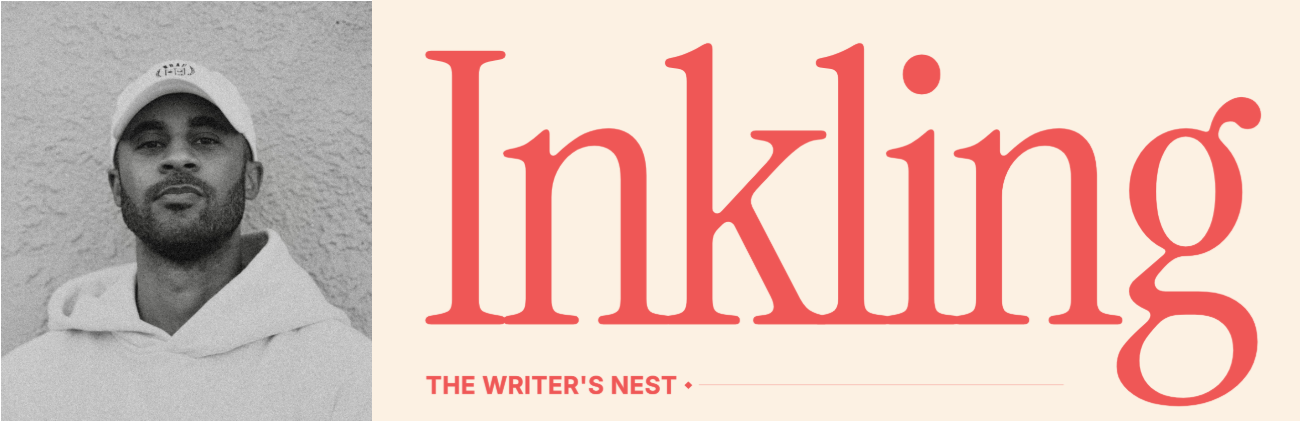
Mattew R. Manning is an alumni of DePaul’s M.A. in Writing and Publishing. This afternoon, the online writing resource platform, Inkling, that he started with his co-founder, Alyssa Smaldino, opened for public membership. Here is our conversation:
Q: In your words, what is Inkling Writers Collective?
MM: Inkling is a community ecosystem–a community platform–that is centered on craft, community, and career advancement. After graduating grad school, I found that nothing was more formative in my writing than peer editing–being in a community of people that are actively chipping away and workshopping each other’s work and finding the right way to tell stories. It was a good teaching moment for me in that teaching relationships and workshopping relationships don’t have to be hierarchical. It doesn’t have to be a professor with decades of experience informing things, it could also just be a peer who might notice something because they’re ultimately who the reader is. As soon as I graduated, that dissipated.
I like working with people, building collaborations, so I still was able to manufacture some of that community, but a lot of people don’t have that skill set or that passion. And so I thought to myself, what would it be like to build an online space that isn’t focused on the publishing side, but on the craft side? A place where you come to be messy, where you come to work, to ask questions, to workshop, to find your peers, to get resources. What does it look like to pull all of it into one ecosystem? We’ve realized that centering it on craft, community, and career advancement is the best way to frame it.
Q: How can you imagine the DePaul student reading this blog post right now using this resource?
MM: Inkling is something that can supplement writers now by providing access to tools and resources. We provide access to workshops and communities that might be more specified, or at least supplement some of what you might get at the university level. And also access to fellowship applications, access to job opportunities, access to the community if you’re looking for a quick contract or something. So regardless of what your goals are, if you’re trying to build more of the writing into your ecosystem as a personal writer or as a professional writer, Inkling provides a lot of different pathways for those opportunities and connection points.
All of these things are available to students, obviously, but I think once folks graduate, I think that’s really where this platform starts to shine, because then you can also augment some of that community building that you’ve done in school with a community that lives elsewhere. There’s a whole member portal where you can see where folks are based and we will do pop-up events in a lot of the major cities, including Chicago, LA, New York, Stockholm, London, et cetera. So writers in those locations can also gather physically.
And there’s always all the digital spaces. We have a coworking room that’s open 24/7. The thought is that as members begin to join there’s always somebody in there working from some part of the world. So you can hop in and just sit and work and write with somebody else sharing space.
So now Inkling also becomes kind of a career advancement tool and a community supplement where you can continue to build on the momentum you built in school
Q: You’ve had a pretty diverse career, you started a Black brand agency, Gumbo Media LLC., worked as a motivational speaker–why this now?
MM: Writing is kind of the red thread through all of my experiences. Gumbo was a small brand agency that I ran for almost 10 years. I’m in the process of shutting that down now–it kind of came to a natural end. It was more novel when we started it. We were one of the few like Black owned brand agencies that existed telling our stories and leaning into our diverse perspectives. That gap isn’t as prevalent now, which is great. (Gumbo) was ultimately storytelling. We were helping to tell the stories of around 200 clients from across different sectors, industries, projects… Even when we got to work with Nike, it was amplifying the voices of this black, queer, femme skate crew in Chicago that was like disrupting the scene. We were always at the intersection of representation and culture and everything that we did. So all of these were cool opportunities with, like, sometimes some really big companies, a lot of times really small mom and pop shops, but it was always advancing story.
Motivational speaking–using words, using powerful stories from children around the world to motivate kids across the country. So storytelling and writing were kind of that through line that undergirded all of those opportunities.
And I wanted to kind of come back to that. I’m at the place where I’ve been telling a lot of other people’s stories for a long time. I want to start telling more of my own, and (Inkling) is the community that I feel like I need in order to support my own goals in writing, and I know if I need it, others might too.
I sent out messages to dozens of people asking Is this something you even want? before I started actually working on the idea. And people responded Oh my gosh, this is exactly what I’m looking for as a writer! Writers want this stuff. They often lack the scaffolding and the support to get into a lot of these institutions from a publishing standpoint. That’s the goal of a lot of folks and it’s really difficult to do. It can get very frustrating, it can get very lonely and isolating. You start to doubt your capacity, and it’s like, no, there are people out there looking for you and what you have to offer–your gifts in storytelling. So this community kind of gives people more support and holistically that allows them to keep that momentum up, keep building towards their goals, and do that in community with other people, which is what I felt like I needed.
Q: On your website, it said you’re creating this collective because it’s what you wanted and needed as a writer. I’m curious if there was a moment where you realized that this is something that you’ve been lacking this whole time.
MM: I don’t know if there was an exact moment. I think it was that quiet gnawing. After I graduated from grad school, I was like, wow, it is so much harder to do this by myself. If I am presenting on this day, and I need to have it in by this day, in order for seven other people to read it, and then actively critique it. That helps me get my stuff together, and it helps me focus and get it done. Sometimes it feels forced, but sometimes you need kind of that forced momentum to start flowing. And what is it that people say to writers all the time about what it takes to be a writer? You gotta write all the time, you gotta read all the time. That’s hard to do when you’re busy and you get older and now you have other obligations and life has more risk than it did before. I can’t just take all the time in the world now because I have a family. Ten years ago, that was different. Five years ago, that was different.
Inkling creates structured space that holds you accountable to yourself and to others. And it invests in you what you invest in it. If you have goals where you just want some support, you want some community, you want to get some creative inspiration from one of the writing prompts, you can do that. If you want to basically become a student again, and get a full supplementary education from this space, you can do that too. If you want to engage in all of the workshops, build new connections, meet people, and actually go meet up in your city or state, you can do that. So, I think it meets people where they’re at–it doesn’t try to project any type of learning onto you. It’s a platform that has all of it available so that you can kind of pick and choose what journey makes sense for you.
But the goal is that craft is at the center. We are constantly working on bettering ourselves as writers, and we’re not putting our dreams down.
